Following in Lee Chang-ho 9-dan’s footsteps as the leading figure in Korean Go, Shin Jinseo 9-dan has never lost to a Japanese player since turning professional in 2012 — an astonishing record of 45 wins, 0 losses.
At the 2025 Nongshim Cup, he pulled off a comeback win from a 16-point deficit, extending a win streak that had run since the 22nd tournament (held 2020–2021) to 21 straight victories. That result also completed Team Korea’s sixth consecutive title and pushed his career prize money past 10 billion won.
Known for his high move-match rate with the AI program AlphaGo — earning him the nickname “AI Shin” (신공지능) — Shin Jinseo is also famous as a largely self-taught player who rose to the very top level of the game.
Born in 2000 to a father who held an amateur 5-dan and ran a Go institute, Shin showed standout talent for his age, and it was through training even more intense than what a typical Go academy offered that “AI Shin” was forged.
By 2009 he had no rivals left among child players, so his parents closed their business in Busan and moved to Seoul; in 2012, Shin Jinseo began his professional career via the child-prodigy entry tournament and has since become Korea’s ace.
After failing to qualify in the 2011 entry tournament, he went home and — instead of the whole roast chicken he ate every day — could only bring himself to eat half, a moment of frustration. Even as an elementary school student he trained with the intensity of an exam-prep student, pouring everything into the game, and that grinding process is what produced today’s “AI Shin.”
Here is the life story of “AI Shin” Shin Jinseo, on his path to becoming the world’s undisputed No. 1.
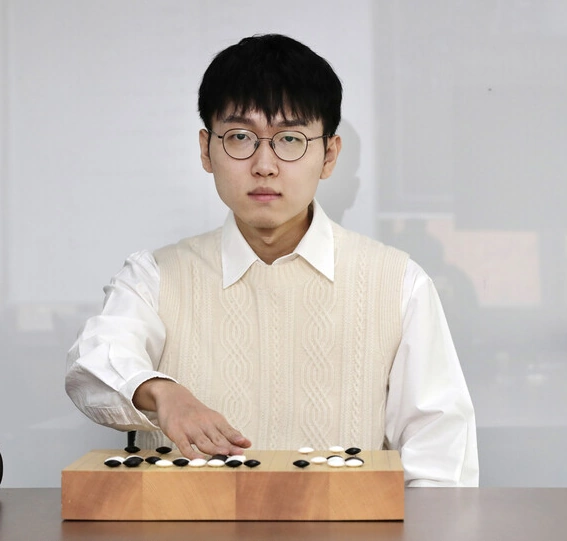
Table of Contents
“AI Shin” 9-Dan Shin Jinseo’s Go Story
Born March 17, 2000, in Dadae-dong, Saha-gu, Busan, to a father who held an amateur 5-dan and ran a Go institute, Shin is a largely self-taught prodigy. His exceptional talent showed early — he began learning Go from his parents at age five, and built up his skill mostly through self-study until his final year of elementary school, turning professional in 2012 as a prodigy player.
Behind this lay enormous effort: by around age six he was already moving between 6-dan and 7-dan on internet Go servers, and his father asked an acquaintance, instructor Kwon Byeong-seop, to give him hands-on training every Saturday. Studying at his father’s Go academy, training online, and doing practical training with his teacher on weekends, by around age eight and a half his skill had become comparable to his teacher’s online 9-dan level, and he began training as an insei (연구생, a Go player-in-training).
He then trained as an insei in the Busan region, competed in national children’s tournaments, and traveled between Busan and Seoul on weekends to take part in the Korea Baduk Association’s insei program. In the first year of sixth grade he moved to Seoul to study at the Chungam Go academy, and five months later turned professional in 2012 via the child-prodigy entry tournament.
Through 2018 he was unbeatable in domestic Go leagues, but on the international stage he suffered decisive losses to Chinese players such as Dang Yifei and Ke Jie, drawing some mocking as a “hometown champion” from critics. In November 2018, he ended Park Jeong-hwan 9-dan’s 59-month hold on the No. 1 spot to claim the top Korean ranking for the first time.
Then in 2020 he set an unprecedented record with an 88.37% win rate (76 wins, 10 losses), surpassing Lee Chang-ho’s mark. That same year, at the 24th LG Cup, he defeated Park Jeong-hwan to win his first major title, marking not just domestic dominance but the beginning of his conquest of the world stage.
In 2022 he recorded annual prize money of 1.44 billion won, surpassing Lee Sedol’s record, and went on to top the annual earnings ranking for five straight years through 2024. From his 2012 debut through early 2026, he passed 900 career wins, maintaining an overwhelming number of wins and a high win rate (a career-best of 88.37% in a single year) while holding onto the No. 1 Korean ranking.
A combative, territory-oriented player built on fast reading ability, he was noted in his youth for a playing style similar to Lee Sedol 9-dan’s. He favors pressing his advantage — starting kos or pressuring opponents even when already ahead — and tends to play forcefully right to the end. Since 2020, his high move-match rate with AlphaGo has stemmed from spending long hours in front of a computer preparing openings, which is how he became “AI Shin.”
Shin Jinseo Career Records & Profile
Awards
- 2018 – Baduk Grand Prize: Best Player, Most Wins, Best Win Rate, Longest Win Streak
- 2019 – Baduk Grand Prize: Most Wins, Best Win Rate, Longest Win Streak
- 2020 – Baduk Grand Prize: Best Player, Most Wins, Best Win Rate, Longest Win Streak, Most Popular Player
- 2021 – Baduk Grand Prize: Best Player, Most Wins, Best Win Rate, Most Popular Player
- 2022 – Baduk Grand Prize: Best Player, Most Wins, Best Win Rate, Longest Win Streak
- 2023 – Baduk Grand Prize: Best Player, Most Wins, Best Win Rate, Longest Win Streak, Most Popular Player, Special Record Award
- 2024 – Baduk Grand Prize: Best Player, Most Wins, Best Win Rate, Most Popular Player
- 2025 – Baduk Grand Prize: Best Player, Most Popular Player
- 2020 – Winner, 24th LG Cup
- 2021 – Winner, 22nd Nongshim Shin Ramyun Cup; Winner, 13th Chunlan Cup
- 2022 – Winner, 26th LG Cup; Winner, 23rd Nongshim Shin Ramyun Cup; Winner, 27th Samsung Fire & Marine Insurance Cup; Gold medal (men’s team) and bronze medal (individual), Baduk, 19th Hangzhou Asian Games
- 2023 – Winner, 24th Nongshim Shin Ramyun Cup; Winner, 9th Ing Cup
- 2024 – Winner, 28th LG Cup; Winner, 25th Nongshim Shin Ramyun Cup; Winner, 2nd Quzhou-Lanke Cup
- 2025 – Winner, 26th Nongshim Shin Ramyun Cup; Winner, 1st Nanyang Cup; Winner, 1st Sopalcosanol World Best Player Championship
- 2026 – Winner, 27th Nongshim Shin Ramyun Cup
- He turned professional in 2012 through the child-prodigy entry tournament and quickly began to stand out. He was promoted to 9-dan in April 2018, and that September rose to No. 1 in the Korean rankings, becoming Korea’s strongest Go player. Since then he has been the closer who has led Team Korea to consecutive Nongshim Shin Ramyun Cup titles.
Shin Jinseo — Go Record & Statistics
- 2012: 2 games, 0W–2L, 0% win rate.
- 2013: 50 games, 30W–20L, 60% win rate.
- 2014: 83 games, 55W–28L, 66.27% win rate; 2nd Hapcheon-gun Invitational Future Contest.
- 2015: 87 games, 64W–1D–22L, 74.42% win rate; 2015 Let’s Run Park Cup, 3rd Ha Chan-seok Guksu Cup, 3rd Mejion Cup.
- 2016: 73 games, 55W–18L, 75.34% win rate.
- 2017: 69 games, 53W–16L, 76.81% win rate; 4th Globis Cup.
- 2018: 107 games, 82W–25L, 76.64% win rate; 23rd GS Caltex Cup, 4th JTBC Cup.
- 2019: 98 games, 78W–20L, 79.59% win rate; 20th Maxim Coffee Cup, 24th GS Caltex Cup, 31st TV Baduk Asia, 38th KBS Baduk King.
- 2020: 86 games, 76W–10L, 88.37% win rate; 24th LG Cup, 25th GS Caltex Cup, 1st Best Player Championship, 3rd Yongsung Jeon, 39th KBS Baduk King.
- 2021: 97 games, 80W–17L, 82.47% win rate; 2nd Best Player Championship, 26th GS Caltex Cup, 44th Myeongin Jeon, 4th Yongsung Jeon, 13th Chunlan Cup, 40th KBS Baduk King.
- 2022: 95 games, 80W–1D–14L, 85.11% win rate; 26th LG Cup, 3rd Best Player Championship, 5th Yongsung Jeon, 8th Guksusanmaek, 27th GS Caltex Cup, 27th Samsung Fire & Marine Insurance Cup.
- 2023: 127 games, 112W–15L, 88.12% win rate; 9th Ing Cup, 4th Best Player Championship, 6th Yongsung Jeon, 24th Maxim Coffee Cup, 41st KBS Baduk King, 2023 YK Construction Cup, 46th Myeongin Jeon.
- 2024: 81 games, 67W–1D–13L, 83.75% win rate; 5th Best Player Championship, 25th Maxim Coffee Cup, 28th LG Cup, 2nd Lanke Cup.
- 2025: 78 games, 67W–11L, 85.9% win rate; 2025 Hana Bank Super Match, 30th GS Caltex Cup, 48th Myeongin Jeon, 1st Nanyang Cup, 1st World Best Player Championship.
- 2026: Record still being tallied; 27th Nongshim Shin Ramyun Cup.
※ Career total: 1,140 games, 905W–2D–233L, 79.53% win rate; 43 Go tournament titles overall, 9 major world titles, 6 runner-up finishes (as of February 6, 2026)
As of 2025 he ranks No. 1 in the Korea Baduk Association rankings and also holds a commanding No. 1 in the GoRatings world rankings. His career win rate of 79.53% is the highest in Korea Baduk Association history. With 9 major world titles among his 44 career tournament wins, he is regarded as the world’s strongest player who checked the rise of Chinese Go, and is seen as the current No. 1 following Cho Hun-hyun 9-dan, Lee Chang-ho 9-dan, Lee Sedol 9-dan, and Ke Jie 9-dan.
Shin Jinseo — Family & Marriage
His family includes his father Shin Sang-yong (amateur 5-dan, former head of a Go institute), his mother (3-kyu), and one older brother; he remains unmarried. Note that Go operates on a prize-money system rather than salaries, so Shin Jinseo has no fixed annual salary. He has said that if a salary system were ever introduced for professional Go players, he would like to earn 500 million won a year.
Go Jinseo VS Baduk AI KataGo
Shin Jin-seo (26), the world’s top-ranked baduk (Go) 9-dan player, defeated the baduk artificial intelligence KataGo, avenging his loss in the first game.
At a three-game match, the “Ssen Math·Hankyung Kishinjeon,” held on the 19th at the Korea Economic TV studio in Jung-gu, Seoul, Shin Jin-seo won Game 2 against KataGo by 4.5 points as Black. Having lost Game 1 on the 17th by resignation after 245 moves, Shin evened the series at 1-1.
His solution was to reduce variables from the start. Just as in Game 1, KataGo opened with its first move at the upper-left star point. When Shin responded at the lower-right star point, KataGo immediately invaded at the 3-3 point. The two players then rapidly played out to move 53 in just about five minutes, completing a large joseki that occupied a quarter of the board.
This joseki is the so-called “AlphaGo joseki,” which came into widespread use after AlphaGo’s emergence in 2016. Though discovered by AI rather than a human, professional players have studied it for years and mastered most of its variations. Shin did not avoid the complex path and confidently followed the joseki. His strategy was to settle one side of the board early, reducing the unexpected variations KataGo might create.
In Game 1, Shin had been thrown off by an unfamiliar move from KataGo and failed to properly deploy his prepared opening. Though ahead through the middle stage, he suffered a reversal loss after a failed attack to capture a large white group in the center. This time, however, he calmly maintained his advantage within familiar joseki territory.
The decisive battle came in the center. Shin went on the offensive by cutting KataGo’s stones, and accurately read out and blocked KataGo’s final decisive move that followed in the lower-center area. Drinking 11 bottles of water throughout the game to maintain his focus, Shin left no openings in the endgame and secured the win.
After the match, Shin said he had thought his preparation was excellent, but KataGo attacked so relentlessly that at one point he thought he would lose. He added that after calmly recalculating, he composed himself, and that he was glad to have earned such a valuable win.
This match marks the first face-off between a top human player and AI in ten years, since Lee Sedol 9-dan’s match against AlphaGo in 2016. Given how much AI’s playing strength has improved since then, the match was held as a two-stone handicap game, with Shin placing two Black stones on the board before play began.
The three-game match will be played out in full regardless of the outcome of individual games. Shin will receive appearance fees of 50 million won per game, totaling 150 million won. He also receives an additional 50 million won win bonus for each game he wins, and if he wins two or more games, he will also receive a Genesis G90. With his Game 2 victory, Shin has now secured a 50 million won win bonus as well.
※ [Shin Jinseo vs KataGo Game 2
Shin Jinseo Bio
- English : Shin Jinseo / Hanja: 申眞諝 / Real name: 신진서
- Date of birth: March 17, 2000 (age 26)
- Hometown: Dadae-dong, Saha-gu, Busan / Nationality: South Korea
- Height: 180cm / Weight: – / Blood type: – / MBTI: – / Religion: –
- Education: Gaerim Elementary School (transferred), Chungam Elementary School (graduated), Chungam Middle School (withdrew)
- Military service: Alternative service as an arts/sports personnel (Gold medal, men’s team Go, 2022 Hangzhou Asian Games)
- Family: Unmarried, no children; Father Shin Sang-yong (amateur 5-dan), Mother (3-kyu)
- Debut year: 2012
- Affiliation: Korea Baduk Association
- Link Wikipedia / Baiduwiki